Is an RC Lawn Mower Worth the Investment? An Honest Assessment
Buying any piece of garden equipment involves a calculation that goes beyond the purchase price. You are weighing the cost of the machine against the time it saves, the effort it removes from your routine, the longevity you can expect from it, and the enjoyment – or at least the reduction in frustration – it brings to a task that most people regard as a chore rather than a pleasure. For an RC lawn mower, this calculation has become increasingly favourable as prices have come down and quality has improved.
The honest answer to whether an RC lawn mower is worth the investment depends on your specific situation – your lawn’s terrain, your physical circumstances, how you value your time, and what you are currently spending on alternative mowing solutions. This assessment works through each of these factors with the aim of helping you arrive at a conclusion that reflects your reality rather than the best-case scenario.
The Time and Effort Argument
If you spend an hour every week pushing a conventional mower around your garden from April to October, that is roughly 26 hours of physical effort per season. Over five years – a reasonable working lifespan for quality garden equipment – that is 130 hours. Quantifying the value of those hours is personal, but for most working adults, the time has value that justifies meaningful equipment investment.
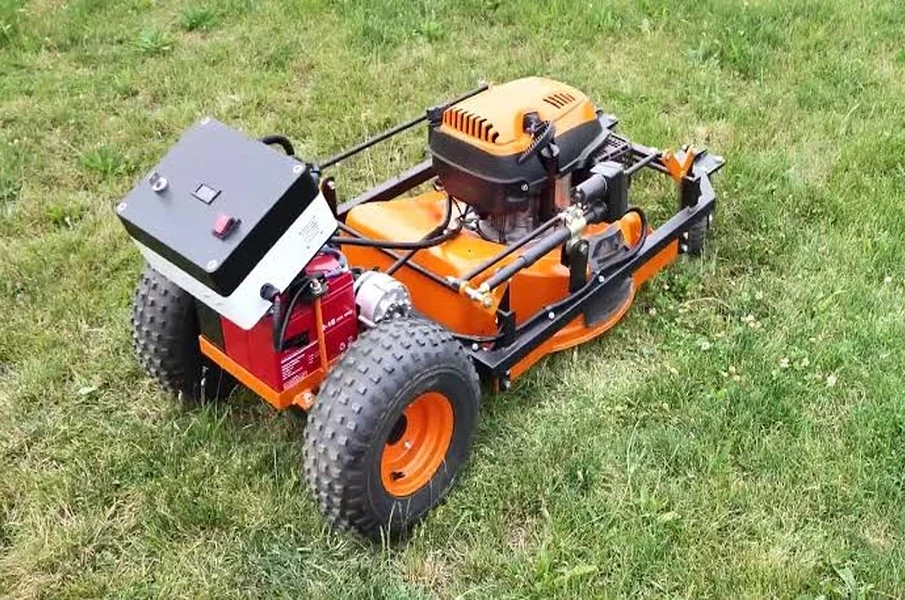
A remote controlled mower does not eliminate your involvement in the mowing process, but it changes its character significantly. Directing a mower from a fixed position for 45 minutes is meaningfully less physically demanding than walking behind one for the same duration. For people with back problems, knee issues, or any condition that makes sustained physical exertion difficult, this difference is not merely about convenience – it extends the practical feasibility of managing their own lawn.
Purchase Price vs Running Costs
The upfront cost of a quality RC mower is higher than a conventional push mower in the same capability category. This gap narrows considerably over the equipment’s working life when running costs are included. Electric mowers have lower running costs than petrol alternatives – no fuel, less maintenance, fewer moving parts to service. Battery replacement is the main long-term cost consideration, and modern lithium battery systems have improved enough that a reasonable lifespan between replacements can be expected from quality models.
For anyone currently paying for a lawn care service, the calculation changes significantly. A RC mower that replaces several seasons of professional lawn maintenance can represent genuine cost savings over its lifetime, while giving you more control over when and how the lawn is cut.
Terrain and Property Suitability
The investment case is strongest for properties with challenging terrain. If your lawn is flat, rectangular, and free of obstacles, a conventional mower or a robot mower may serve you just as well for less money. If your garden has significant slopes, irregular shapes, multiple separate areas, or features that require careful navigation, the flexibility and capability of a remote controlled mower justify the premium more clearly.
Long-Term Satisfaction
The owners who report the highest satisfaction with RC mowing equipment tend to have specific problems it solves well – a steep bank they dreaded mowing, a physical limitation that made conventional mowing increasingly difficult, a large area where the time saving is substantial. Those buying primarily for novelty tend to find that the novelty wears off, leaving them with an expensive tool they use less than they intended.
Being honest with yourself about which category you fall into – and whether the remote control lawn mower solves a real problem or satisfies a passing interest – is the most useful thing you can do before committing to the investment. For the right garden and the right owner, it is a purchase that pays back consistently over years.